


Division one · Air Quality
You cannot see what you are breathing. We can — and we fix what put it there, so the cleaning you pay for is the last one you need for years.
8
components, every job
~7
hours on site
1
job per day
10
year regrowth prevention
A vacuum at one register and a photo for the invoice is the industry norm. We work the system the way the NADCA Standard actually specifies — which takes longer, costs more, and is the only version worth paying for.
The problem
Several hundred square feet of interior surface, dark and often damp, with every cubic foot of air in the house passing over it several times an hour. Nothing else in a home combines that much area with that little attention.
On the Gulf Coast the problem compounds. Humidity keeps interior duct surfaces damp for most of the year, and systems run nine months out of twelve. Fouling that might take a decade in a dry climate happens here in a fraction of that.
Cleaning removes what accumulated. Sanitation addresses what is still living. Most companies do neither properly and charge you for both.
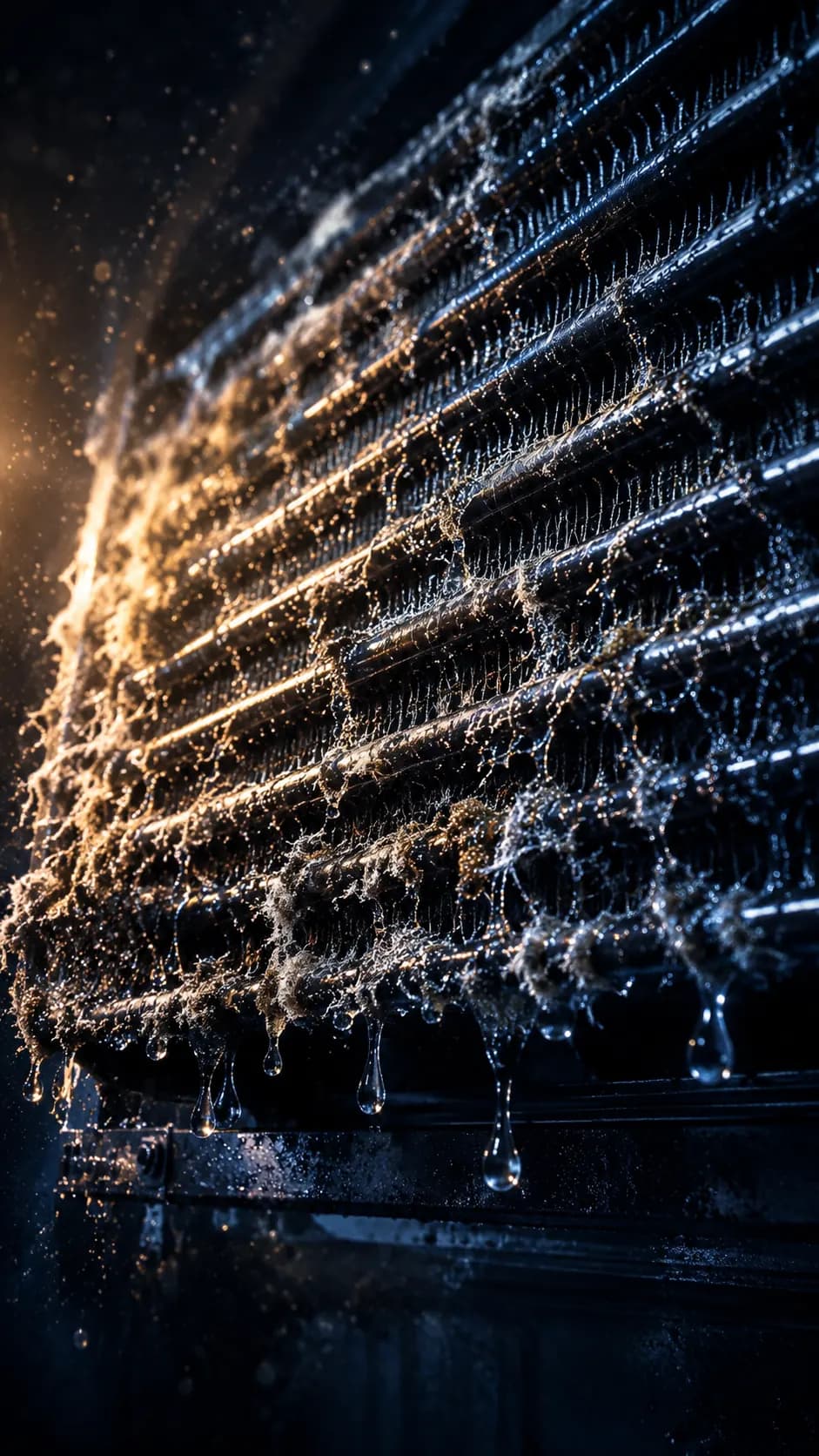
II · Evaporator coil
Cold, wet, and dark. The surface where biological growth starts.
The Standard · Commitment one
Isolated.
Negative pressure is applied to one duct at a time, not broadly across the whole system. The suction stays concentrated where the mechanical agitation is happening, so debris is drawn out through HEPA extraction and leaves the building — instead of being loosened and relocated to another room.
It is slower. It is the difference between removing contamination and moving it around.
One duct at a time
- 01Isolated negative pressure
- 02Mechanical agitation
- 03HEPA extraction
The air pathway
Eight components. Cleaning some of them is cosmetic.
Negative pressure is applied to one duct at a time, isolated, so the suction stays concentrated where the agitation is and the debris leaves the building rather than moving to another room. Then an EPA-registered antimicrobial coating bonds to the duct walls and penetrates the porous insulation — ten years of regrowth prevention, not a surface mist.
IReturn air
Where the house's air re-enters the system — and where the first load of dust and hair collects.
IIEvaporator coils
Cold, wet, and dark. The surface where biological growth starts.
IIIBlower fan assembly
Moves every cubic foot of air. Fouls quietly, and costs airflow when it does.
IVHeating chamber
The cavity around the heat exchanger. Skipped by anyone who does not open the unit.
VPlenum box
The pressure box that feeds every supply run in the house.
VIDuctwork
Hundreds of square feet of interior surface, much of it porous insulation.
VIIRegister boxes
The last box before the room. It catches whatever the duct sends.
VIIIVents and grilles
The part you can see. Cleaning only this is cosmetic.
The subscription
A cleaning you repeat
is not a cleaning.
It is a subscription to a problem nobody fixed. Here is the product, as it is usually sold.
What a cleaning-only company sells you
Repeats every 1–2 years
- 01
The ducts get cleaned
A real day of work, and the debris genuinely leaves.
- 02
It is better for a season
Less dust, less smell. Everyone is happy for a while.
- 03
Nobody touched the cause
The humidity, the return leak, the sizing — all still there.
- 04
The system reloads
The pathway fills from the same source it filled from before.
Then back to step one.
Back to 01. That is the whole product.
What put it there
Six things a cleaning cannot fix.
Standard failure modes of a system in a humid climate. Every one of them refills a clean pathway from the same source it filled from before — and every one of them is an HVAC fault, not a dirt problem.
Growth on the evaporator coil
CauseAn oversized system satisfies the thermostat before it has run long enough to dehumidify. The coil is cold, wet and dark for most of the season.
If only cleanedIt comes back the same summer.
The fixCorrect the sizing and the runtime, then clean the coil.
Ductwork that reloads with dust weeks later
CauseLeaks on the return side pull unconditioned attic or crawlspace air straight past the filter and into the trunk.
If only cleanedThe dust you paid to remove is replaced by more of it.
The fixSeal the return, then clean the pathway.
A musty smell that returns every summer
CauseIndoor humidity is sitting high enough that porous duct insulation never dries out between cycles.
If only cleanedThe smell is gone until the humidity comes back.
The fixBring the humidity down, remove the source, then coat what stays porous.
Registers that never seem to deliver
CauseUndersized, crushed or disconnected runs. Airflow is a duct-geometry problem, not a dirt problem.
If only cleanedA spotless duct that still moves too little air.
The fixMeasure CFM at the register, correct the run, verify it again.
Grit downstream of a filter that looks fine
CauseBypass at the filter rack. Air takes the gap around a filter rather than the resistance through it.
If only cleanedThe pathway loads again from the same gap.
The fixFix the rack and specify the filter, then clean what got past it.
Rust and standing water at the air handler
CauseA condensate drain that cannot keep up, or a coil dirty enough to sweat past the pan.
If only cleanedClean metal, same puddle.
The fixClear the drain, service the coil, confirm the pan runs dry.
Measured
We hand you
the numbers.
Readings are taken outdoors as well as indoors, because an indoor particulate count means nothing without the air outside your door to compare it against. Airflow is measured at the register with a flow hood. The report is yours.
Atmotube PRO 2 · Flow hood (CFM at register)
Primary
- PM1 mass concentration
- PM2.5 mass concentration
- PM0.5 / PM1 / PM2.5 particle counts
- Indoor/outdoor PM1 and PM2.5 ratios
- Supply/return particle ratio
Supporting
- PM10 and PM10 particle count
- Indoor temperature, RH, and dew point
- Outdoor temperature, RH, and dew point
Context
- CO2
- VOC index and TVOC estimate
- NOx index
- Barometric pressure
Indoor air quality report
Sample layout
PM2.5 indoor / outdoor ratio
2.18×
Above 1.0 the house is adding particulate, not removing it.
PM2.5µg/m³
11.4
24.8
2.18×2.18×
PM1µg/m³
7.9
16.2
2.05×2.05×
PM10µg/m³
18.6
41.3
2.22×2.22×
CO2ppm
431
1140
2.65×2.65×
VOC index
98
214
2.18×2.18×
Relative humidity%
78
63
0.81×0.81×
Dew point°F
74.1
60.8
0.82×0.82×
Sample layout. Figures are illustrative of the report format, not results from a job. Airflow is reported per register in CFM.
Division one
Six ways to make the air in a house honest.
The process
A residential job averages 7 hours on site. We book one per day, because the alternative is rushing yours to get to the next one.
Inspect the Air Pathway
Returns, supplies, registers, HVAC components, and filter setup are evaluated — including the contamination points you cannot see from a register. Free, and with no obligation to buy anything.
FREE INSPECTIONSource Removal
Isolated negative pressure, one duct at a time, with mechanical agitation and HEPA extraction. Debris leaves the building instead of moving to another room.
HEPA / ISOLATEDAntimicrobial Coating
An EPA-registered coating bonds to duct walls and penetrates porous insulation, preventing regrowth for a full decade. Applied when appropriate, not automatically.
10-YEARQuestions
Asked before every cleaning.
How often should air ducts be cleaned?
For most homes, every three to five years. On the Gulf Coast we generally recommend the shorter end of that range, because high humidity keeps interior duct surfaces damp and systems run nine months a year. Any company recommending annual duct cleaning to a typical household is selling rather than diagnosing.
What is actually included in air duct cleaning?
All eight components of the air pathway: return air, evaporator coils, blower fan assembly, heating chamber, plenum box, ductwork, register boxes, and vents and grilles. Many companies clean the ductwork and vents only, because the coil and blower require pulling equipment apart to reach.
How long does air duct cleaning take?
A residential job averages about seven hours on site. We schedule one job per day so that yours is never rushed to reach the next one. A company quoting forty-five minutes for a whole house is running a vacuum at a few registers.
What makes your process different from other duct cleaners?
Isolated negative pressure. Most companies pull broad suction across the whole system at once. We isolate and work one duct at a time, which keeps the suction concentrated exactly where the mechanical agitation is happening. It is slower and materially more effective at removing debris rather than relocating it.
Is the antimicrobial coating safe, and how long does it last?
We use an EPA-registered antimicrobial coating rated for HVAC systems. It bonds to duct walls and penetrates porous insulation rather than sitting on the surface as a mist, and it prevents regrowth for a full decade. The product used is logged on your report.
Do you test air quality before and after?
Yes. We take particulate, humidity, CO2, VOC, and NOx readings both indoors and outdoors, since an indoor reading is only meaningful relative to the outdoor air that day. We also measure airflow at the register with a flow hood. You receive a written report.
Is the inspection really free?
Yes, and there is no obligation to buy anything. We evaluate returns, supplies, registers, HVAC components, and filter setup, then explain what we found before any work begins. If your system does not need the work, we will tell you that.
Do you handle mold in HVAC systems?
Yes, following a strict NADCA-compliant process: HEPA vacuum negative-pressure source removal, mechanical cleaning of all duct surfaces, EPA-registered antimicrobial coating to prevent regrowth, and post-cleaning verification.
Excellence Comes Standard